report on season's progress - November 2010
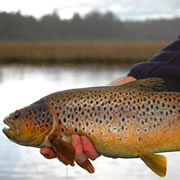
Improvements in the fishery prior to the current season included restocking both lakes Samuel and Big Jim with fingerling brown trout and transferring about a hundred adult brown trout tro the Oxford Ponds. Raising the level of the levee on the impoundment at the outflow of the Ponds formed an extensive area of new wading water over shallow grasses, into which 500 young tiger trout were released in August.
Excellent winter rains pushed the lakes to similar levels to those of last season (see below). However, unusually cold weather slowed fishing for tailing trout in August and September, as did unseasonable snows in October. During this time, midge fishing was the mainstay of the fishery. On cold, calm mornings, anglers sometimes could present their flies to upwards of 60 fish up to six pounds on Big Jim.
At the time of writing, dun hatches have commenced in both lakes.
Season's Report - 2009-2010
 It was a welcome surprise when record heavy winter rains refreshed the fishery
for the current season with clean, cold mountain waters. Lake Samuel
overflowed and Lake Big Jim rose into trees beyond sweetened shores where pondweed dieback left the lush, short lawns that are ideal for tailers and polaroiding. We have been able to open the valves on Big Jim and maintain steady flows through the runnels and weirs of the Oxford Pools. These
man-made streams hold brown trout to five pounds and provide challenging alternatives for more experienced fishers.
It was a welcome surprise when record heavy winter rains refreshed the fishery
for the current season with clean, cold mountain waters. Lake Samuel
overflowed and Lake Big Jim rose into trees beyond sweetened shores where pondweed dieback left the lush, short lawns that are ideal for tailers and polaroiding. We have been able to open the valves on Big Jim and maintain steady flows through the runnels and weirs of the Oxford Pools. These
man-made streams hold brown trout to five pounds and provide challenging alternatives for more experienced fishers.
The timing of the rains ensured winter spawning was the best for many years. Thousands of trout swam up the creek on Big Jim. Numbers of big browns and rainbows also ran upstream from Lake Samuel.
Though spring brought variable weather, trout were soon seen feeding everywhere around the edges of Big Jim and in hot spots on Samuel such as Snipe Bay. Heavy hatches of chironomid (midges) encouraged rising trout on still early mornings and evenings on both lakes.
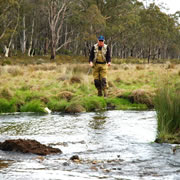 However, from September, the trouts' phenomenal tailing activity for caddis larvae, snails and drowned worms dominated the fishing, much of which involved trickling a double rig amongst sticks and trees to fish that were tailing at rod's length...and hanging on! Several clients were amazed to polaroid and to catch fish on the (flooded) gravel track at the south-west corner of Levett's Bay. As mid-summer approaches, we are still catching fish in the receding shallows, especially by polaroiding them.
Because Lakes Samuel and Big Jim are lower than the lakes of the Central Plateau, prolific hatches of the Highland Dun appear earlier on our waters, historically commencing in late October and peaking during December. Lake Samuel in particular produces hatches that can very dense in specific locations, attracting large numbers of fish to gorge on the nymph, sub-imago or adult stages. This year, duns were reported by mid-September and, although not as numerous as usual in November, they have continued to appear into January and seem to be emulating last season, when emergers persisted through the summer.
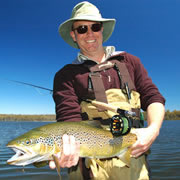 October marked the first of the evening caddis fly hatches. November
and December also provided windlane fishing to midging
fish from daylight until bright sunshine put the fish
down. Another tiny mayfly, the caenid, also hatches from mid November through to the end of January. Fish feed very singlemindedly when this happens and It is not unusual for anglers to cover sixty large fish in a session. Bags of twelve to fifteen trout a day are achievable when anglers are sufficiently proficient to drop a small imitation a few inches in front of their target. Last season, caenids appeared earlier and persisted later, a pattern that seems to be reoccurring.
October marked the first of the evening caddis fly hatches. November
and December also provided windlane fishing to midging
fish from daylight until bright sunshine put the fish
down. Another tiny mayfly, the caenid, also hatches from mid November through to the end of January. Fish feed very singlemindedly when this happens and It is not unusual for anglers to cover sixty large fish in a session. Bags of twelve to fifteen trout a day are achievable when anglers are sufficiently proficient to drop a small imitation a few inches in front of their target. Last season, caenids appeared earlier and persisted later, a pattern that seems to be reoccurring.
The red spinner hatch during December and January also can be prolific. This season already has seen increased numbers of mayflies on Big Jim, where Graeme Ferran landed 38 browns in four days before wild weather disrupted fishing in the second half of November.
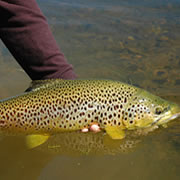 Gum beetle falls from the eucalyptus trees that surround London Lakes have been yielding fish on hot days throughout December, as has polaroiding the shallow edges of both waters. A repeat of of the regular falls last year will see March, April
and May produce unbelievable gum beetle fishing on London Lakes and surrounding
waters, especially if it coincides with hatches of what is perhaps the favourite terrestrial food
of all wild highland Tasmanian trout - the jassid leaf hopper. A good hatch of red and black jassids occurs once a decade and is due!
Gum beetle falls from the eucalyptus trees that surround London Lakes have been yielding fish on hot days throughout December, as has polaroiding the shallow edges of both waters. A repeat of of the regular falls last year will see March, April
and May produce unbelievable gum beetle fishing on London Lakes and surrounding
waters, especially if it coincides with hatches of what is perhaps the favourite terrestrial food
of all wild highland Tasmanian trout - the jassid leaf hopper. A good hatch of red and black jassids occurs once a decade and is due!
We have observed these waters for thirty years. Although no consecutive years have ever offered identical conditions, the aquatic cycles are consistent and the fishing generally is superior to any other public or private waters in Tasmania. We invite you to explore these wonderfull waters and their complexities.
return to the main fishing page >>